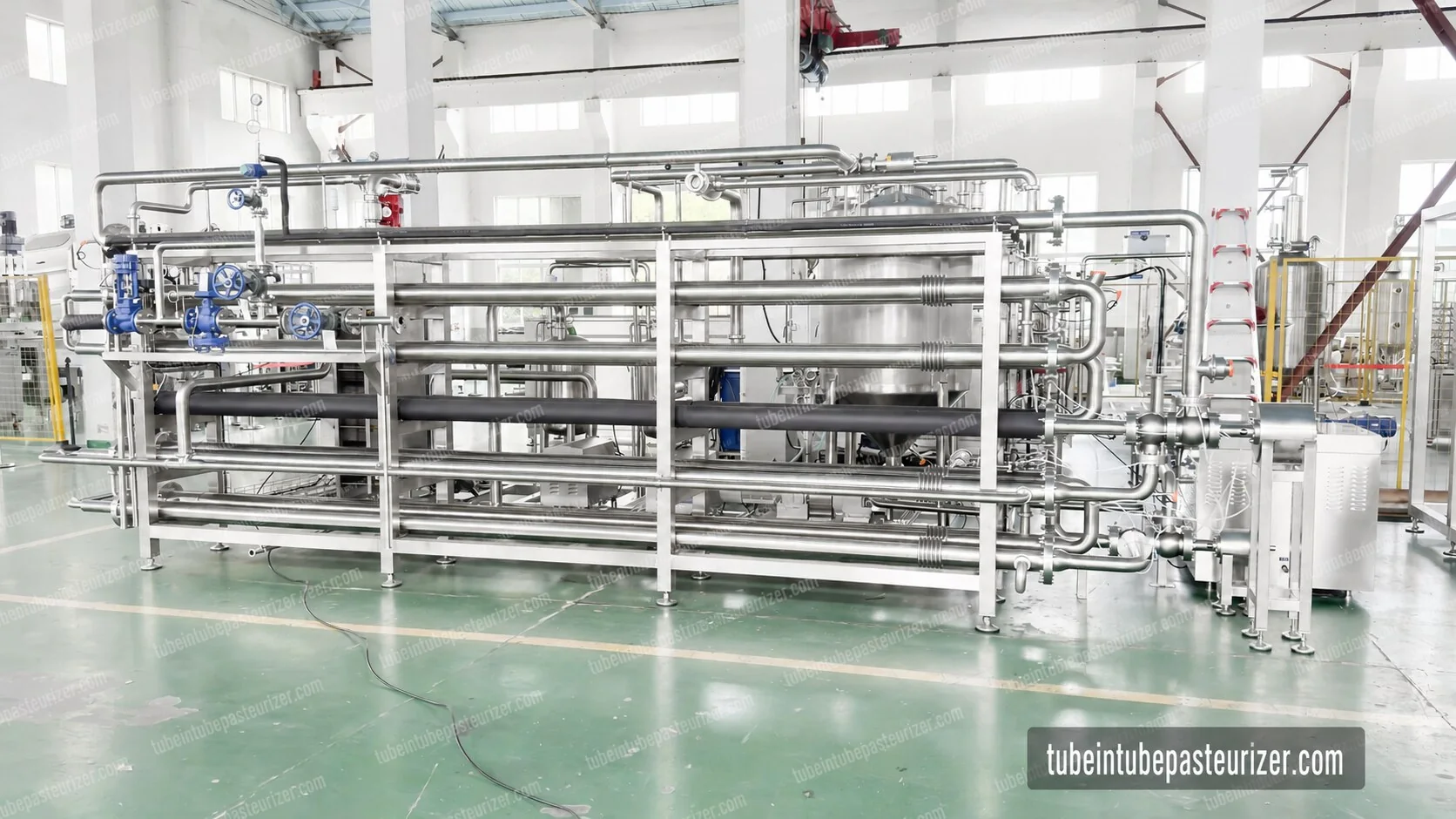
A connected processing system, built around the tube banks
The long horizontal tube runs form a supported assembly with return bends, valves and instruments distributed along the frame. Connections at the ends join the sections into the selected circuit. The controls and transfer arrangement coordinate the product stream with heating and cooling services.
The equipment can be specified as a thermal-processing section for an existing plant. Feed preparation, storage and filling may remain with the surrounding line, while the pasteurizer receives a defined product and supplies a defined outlet condition. The supply scope identifies those connections along with the pumps, vessels and controls included in the selected assembly.
Product and utility flow through separate passages
Concentric tubes form neighboring product and service passages. Heat passes through the intervening metal walls while food and utility remain separate. The family includes a four-layer concentric arrangement; the selected passage dimensions and circuit connections establish how that configuration handles the product.
Particle profile, fibres and viscosity affect passage selection and pressure loss. A passage that can physically admit a particle does not by itself establish the heating of that particle. The required product process and the mechanical flow route are assessed together.
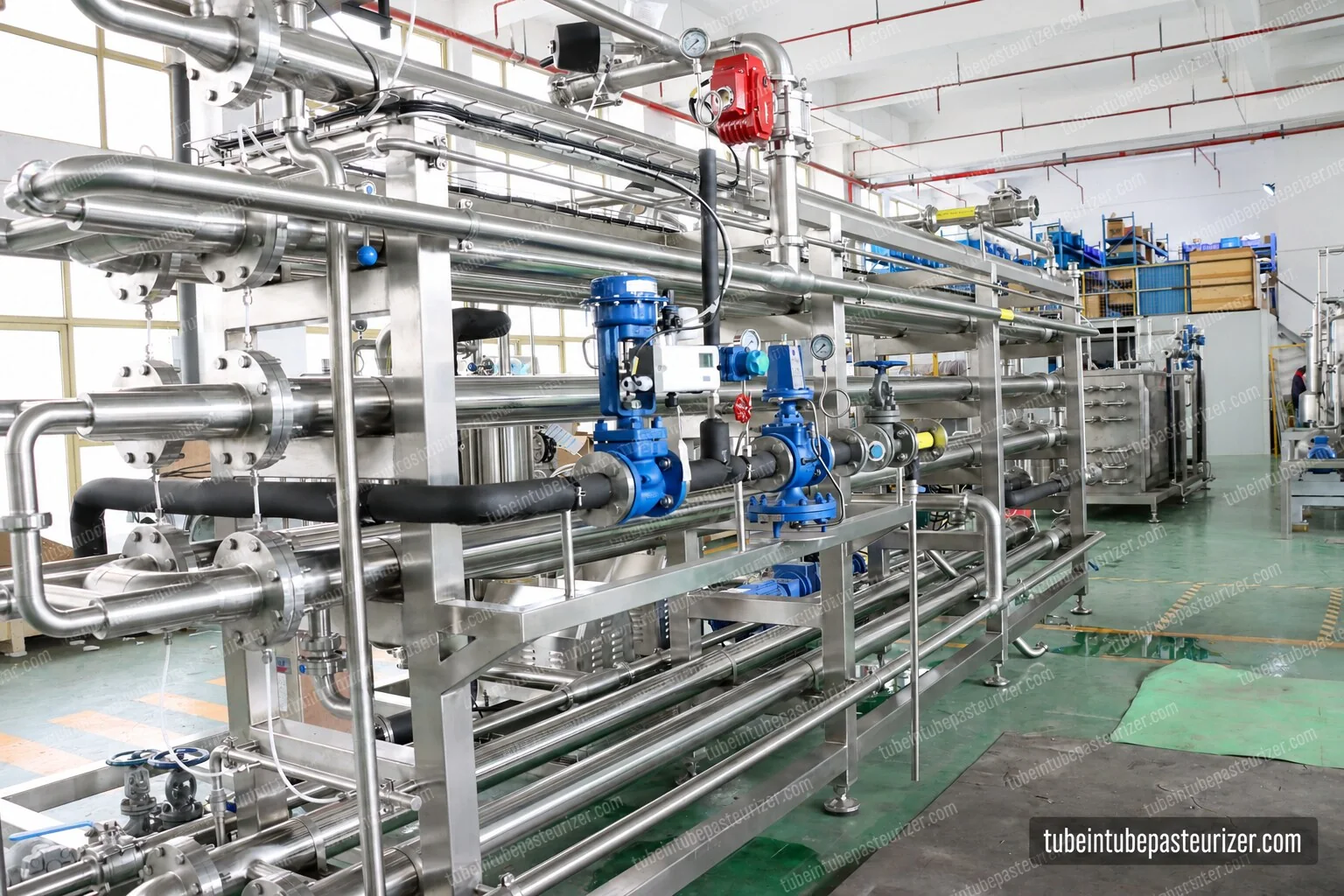
Steady feed makes the holding section useful
The feed arrangement supplies the heating section without repeated starvation or large flow surges. Product-pump selection accounts for inlet temperature, viscosity, particles and the resistance of the complete circuit. A balance or feed vessel can be included where the process needs it; its working levels and pump controls form part of the chosen configuration.
After heating, a defined holding section provides residence before the next stage. Its dimensions and the accepted flow range must be linked to the product process. Dividing volume by flow gives a nominal mean residence; the process assessment still needs to address the actual flow behaviour and, where relevant, the particle residence and heating history.
Set the heating and cooling duty as one sequence
Heating service supplies the required heat through the exchanger wall. The selected arrangement coordinates product feed, service circulation and temperature measurement so that the operating condition remains controlled as the incoming temperature or flow changes.
Cooling then prepares the product for the next operation. Its duty depends on the thermal exit condition, available cooling service and required outlet temperature. A chilled bulk route, a hot-filling route and an aseptic connection call for different handoffs.
The following values are references for the wider configurable thermal-equipment family. The range includes duties beyond pasteurization; each proposed operating point must match the selected construction and the validated product and package process.
| Item | Family reference or option | Selection condition |
|---|---|---|
| Treatment temperature | 72–150 °C | Choose the product duty and compatible system configuration |
| Holding time | 15–120 seconds | Specify holding arrangement and accepted flow range |
| Heating service | Hot water or steam options | Confirm service pressure, temperature and supply arrangement |
| Cooling service | Cooling water or chilled-water options | Match available service to the required product outlet |
| Contact construction | 304 or 316L stainless steel options | Check product, cleaning exposure and selected seals |
| Processing rate | Specified for the actual duty | Use product temperature, viscosity, particles and circuit resistance |
Controls follow the operating state
A separate control panel with PLC and operator interface provides the system control platform. Temperature recording and level or temperature monitoring can be included in the selected package. The operating sequence distinguishes preparation, product running, interruptions and cleaning.
For a configured return or diversion arrangement, the routing response and release condition must agree with the product process. Define what happens after inadequate heating, loss of feed, loss of a utility or a downstream stop. Control review covers the actual valve arrangement and sensors rather than relying on a temperature display alone.
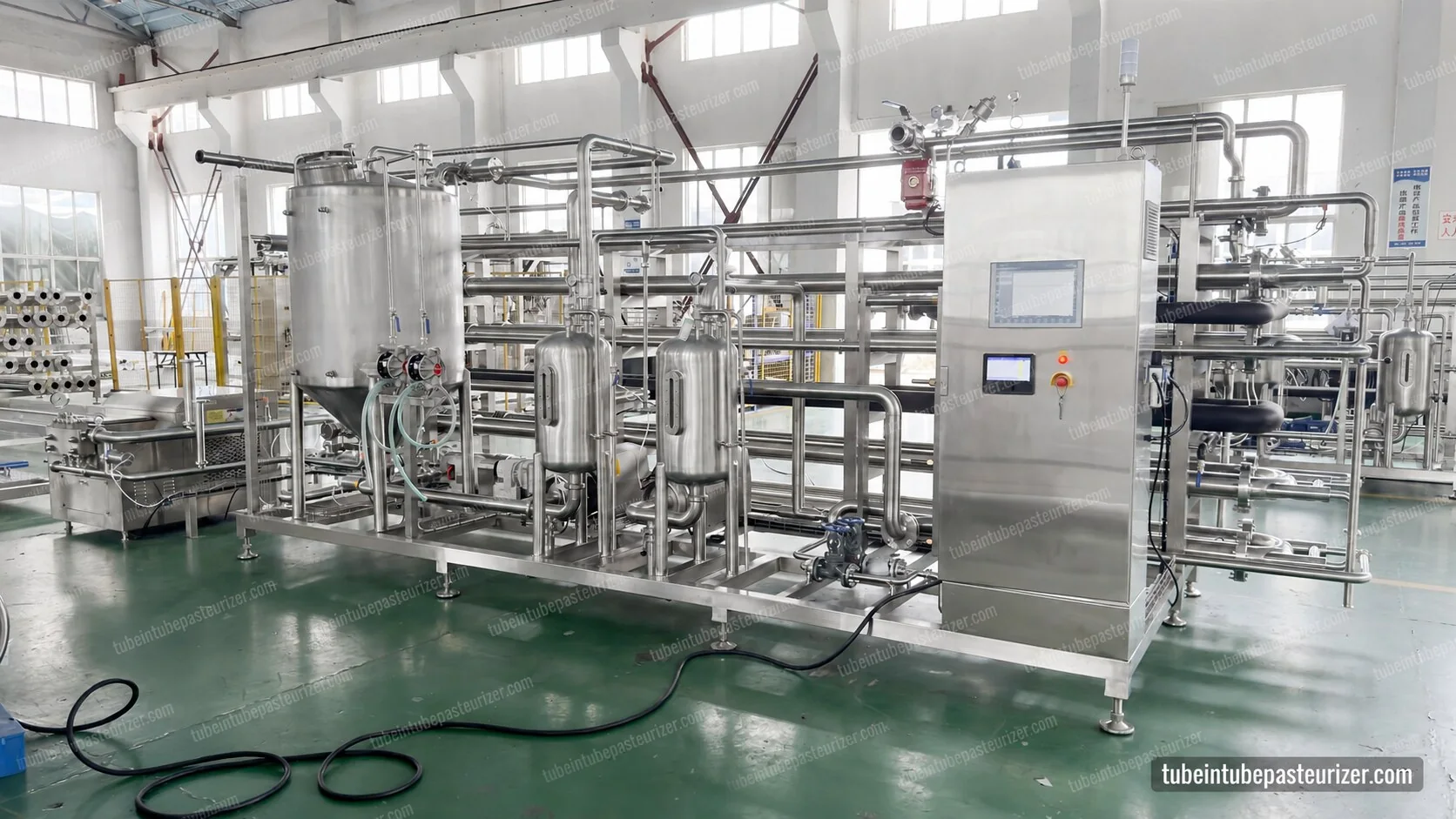
Choose the configuration for how the food flows
A clear juice and a thick sauce can require different product-pump and heat-transfer selections even when the equipment serves a similar temperature duty. Specify the product at the temperatures it will encounter, including startup and cooling. One room-temperature viscosity value may not describe the whole run.
The configurations below describe selection priorities within the system family. They are not separate model ratings or a reason to add every optional treatment to one line.
| Product condition | Configuration priority | What to assess with the product |
|---|---|---|
| Juice or smooth, readily pumpable feed | Controlled feed and suitable heating/cooling duty | Flow stability, outlet condition and any required fibre handling |
| Pulpy or fibrous puree | Passage and transfer arrangement matched to the feed | Particle profile, pressure loss, texture and temperature history |
| Viscous sauce or paste | Pump duty and heat transfer through the operating range | Viscosity at temperature, fouling tendency and retained product |
| Formulation requiring air or texture treatment | Separately selected deaeration or homogenization integration | Actual benefit to the recipe and position in the hygienic process |
Define the inlet and outlet before fixing the layout
The incoming connection describes the product state, supply pressure, flow range and available feed control. The outlet connection describes temperature, pressure and the receiving equipment’s response during normal running and stops. These two interfaces determine how the pasteurizer fits an existing process.
Heating and cooling supplies, electrical service, drains and the cleaning supply/return need their own connection schedule. Product and utility design pressures are established for their respective circuits. Instrument and maintenance access must remain usable once surrounding piping is installed.
An aseptic filling route requires the appropriate downstream equipment and a maintained hygienic process boundary. Homogenization, vacuum deaeration and bag filling are separately configured connections; they are not assumed to be included with every pasteurizer.
Give cleaning a complete supply and return path
CIP connections allow cleaning media to circulate through the selected product circuit. The route includes the relevant pumps, valves, tube sections and branches, with a defined return and drainage arrangement. Cleaning conditions are chosen for the food residue, heat exposure and equipment configuration.
Sterilization-in-place can be included where the chosen system and operating process require it. It serves a different purpose from residue removal and does not follow automatically from having a CIP connection. The selected preparation and return-to-production sequence should reflect that distinction.
Inspect retained product at low points, seals and isolated branches. A practical cleaning check considers the return condition and accessible internal surfaces, as well as the values displayed at the cleaning supply.
Keep joints and instruments serviceable
End connections, return bends and the supporting frame establish how the tube assembly can be accessed. Leave the clearances required for the selected removable joints and service components. Isolation, depressurization and cooling precede opening the relevant circuit.
Maintenance includes checking seals, connections, valves and instruments for the selected duty. Deposits can change pressure loss and heat-transfer behaviour; compare operating observations at a consistent product condition before attributing a change to throughput alone. The parts list should identify the fitted components and compatible replacements.
Connect construction, checking and site integration
An assembled skid gives the project team a practical basis for reviewing pipe routes, component access, utility connections and the control-panel position. The selected supply can include process design, layout, utility coordination, installation and commissioning support, operator training and equipment documentation.
Agree checks that suit the supplied scope: construction and connection review, appropriate pressure or leak checks, instrument checks, control-sequence demonstration and the intended water or product trial. A water run can demonstrate circulation and sequence operation; it does not replace a trial for the food’s heating, pressure loss or texture.
Handover should identify the supplied assembly, circuit drawings, selected instruments, operating and cleaning instructions, serviceable parts and agreed acceptance records. Product-process validation remains specific to the food and packaging route rather than being inferred from the appearance of a completed skid.