Start with the actual flow path
Concentric tube-in-tube sections place food and heating/cooling service in neighboring passages. A multi-tube unit distributes food through a bundle of tubes inside a shell. A plate unit routes fluids through formed plate channels.
That physical difference changes velocity, pressure loss, surface access and product clearance. Compare the selected passage geometry, service access and product conditions in the equipment proposal.
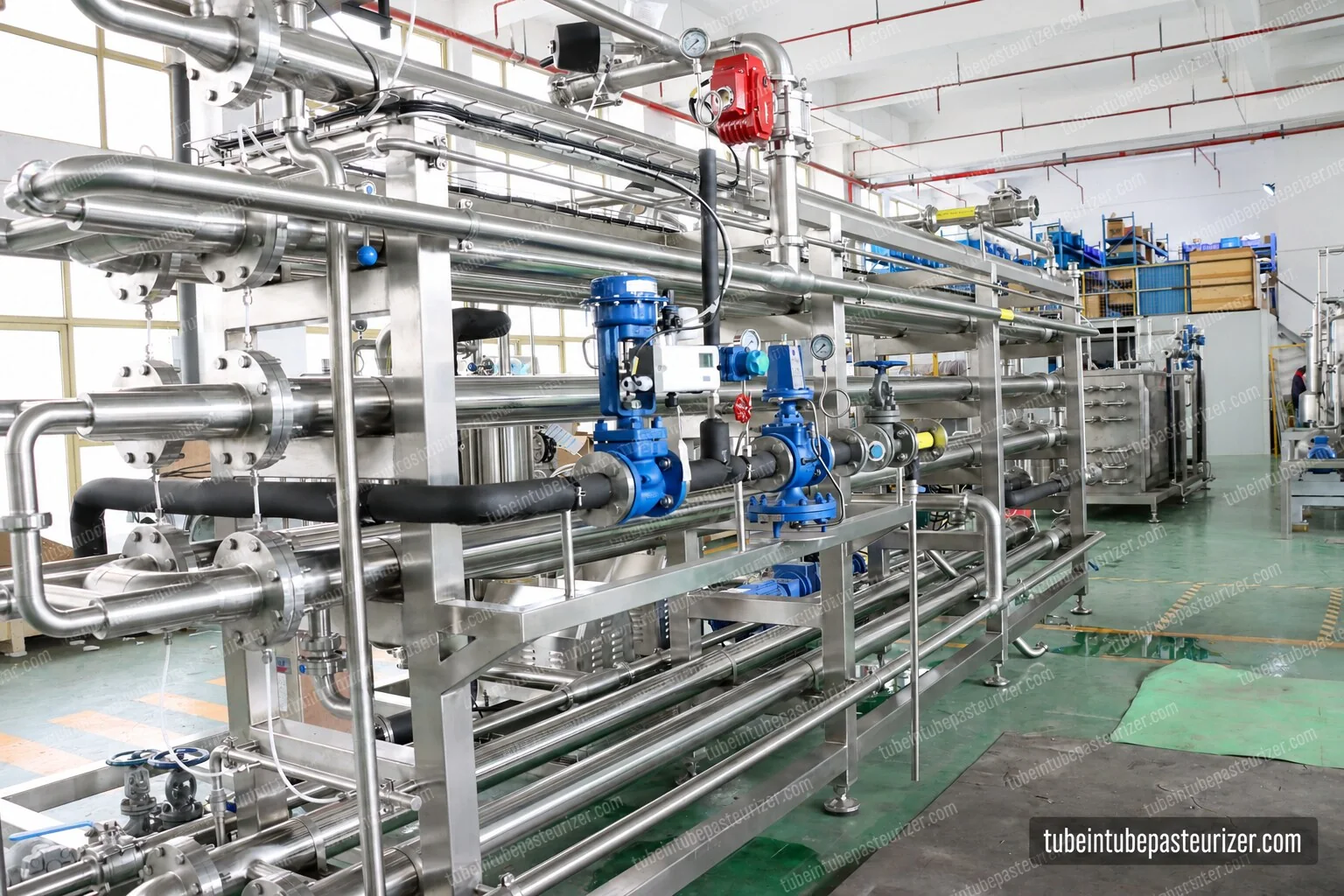
Compare under the same product duty
An apparently larger opening does not establish particle heat treatment. Specify the food, particle profile, viscosity at the working temperatures, flow, thermal duty, pressure limit and cleaning plan. Then compare candidate exchanger forms at those conditions.
| Geometry | Primary physical distinction | Selection question |
|---|---|---|
| Concentric tube-in-tube | Nested product/service passages | Does the selected passage and pump carry the food at the required duty? |
| Multi-tube bundle | Several product tubes share a shell | How is flow shared and each tube inspected or cleaned? |
| Plate channels | Narrow passages between plates | Does the food condition fit the plate pattern and cleanability? |
The next process still matters
Heating, holding and cooling have to match the intended packaging route. Choosing an exchanger form alone does not establish a pasteurization schedule, commercial sterility or shelf life.