Follow the product through its temperature range
A room-temperature viscosity number is a starting point. Heat can thin some formulations while starch development or concentration can increase resistance. Pieces, seeds or herbs affect the available passage and cleaning route.
A feed vessel or balance arrangement can stabilize transfer. Pump selection accounts for inlet conditions, product sensitivity and complete circuit pressure loss. Record whether the product is blended before the thermal system or whether that operation is separately supplied.
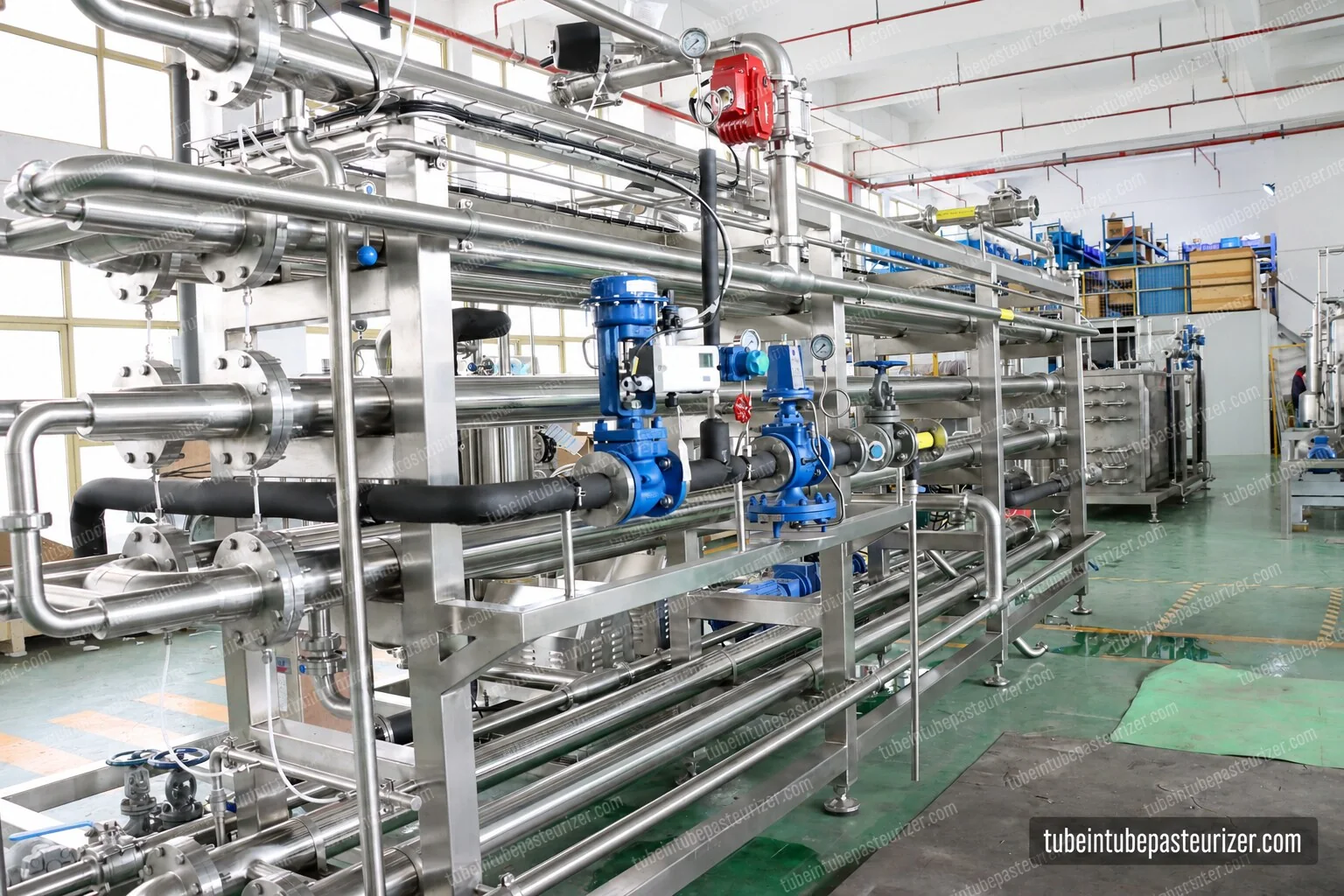
Plan for deposit formation and residence
Product moves through the selected food passage as service fluid transfers heat across the tube wall. The selected circuit needs enough heat-transfer area at the expected flow without imposing unacceptable pressure loss or texture change.
Viscous products can build deposits differently from clear juice. Cleaning frequency, access at bends and joints, and operating observations at comparable product conditions belong in the configuration review.
The pasteurizer is one section of the sauce line
Upstream mixing or deaeration and downstream cooling or filling may be supplied as separate modules or already exist at the site. Specify the product state entering the pasteurizer and the temperature, pressure and continuity expected by the receiving machine.
Hot filling, chilled handling and aseptic filling require different process and package conditions. Selecting a tube passage does not by itself make any of those routes valid.
Different product traits change the engineering work
Use the actual recipe or a representative sample for the final duty.
| Observed trait | Equipment question | Review method |
|---|---|---|
| High viscosity | Can the selected pump and circuit carry the required flow? | Pressure loss at representative temperatures |
| Particles or fibres | Which passage and holding assessment apply? | Distribution, residence and heating history |
| Frequent recipe change | How is product displaced and the circuit cleaned? | Drain, return and transition sequence |