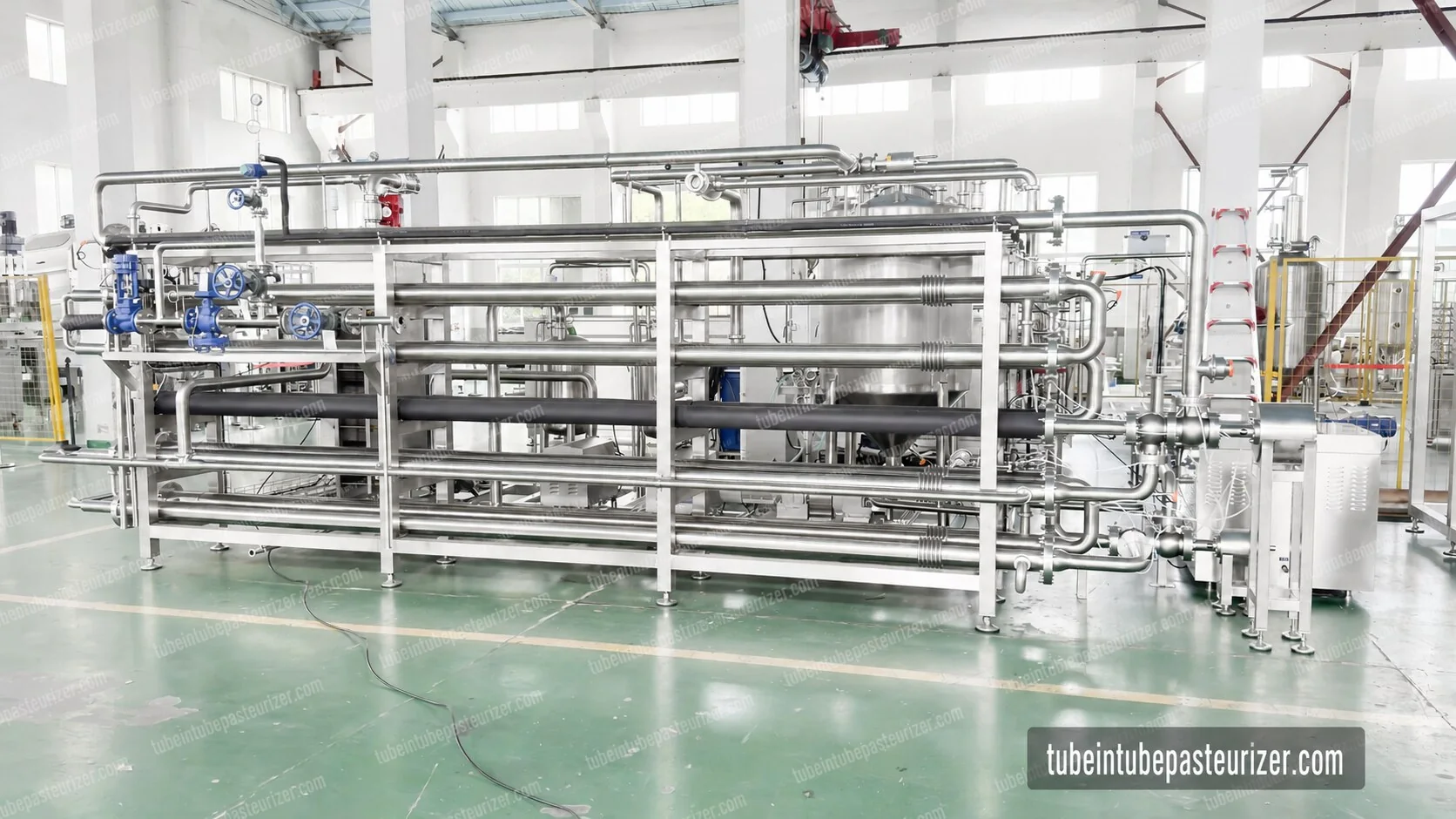
Family reference, with its limits visible
The 2026 industrial thermal-equipment family lists adjustable treatment temperature of 72–150 °C and holding times of 15–120 seconds. These values span duties beyond pasteurization and are not a recommended schedule for every food.
Hot-water or steam heating and cooling-water or chilled-water services are options. Product-contact 304 or 316L stainless construction is selected for the specified duty. A final proposal identifies the exact system, process conditions and utility figures.
| Selection field | Family reference | Must be fixed for the order |
|---|---|---|
| Treatment temperature | 72–150 °C, wider family | Target for product and package process |
| Holding time | 15–120 seconds, wider family | Holding path and accepted flow range |
| Heating service | Hot water or steam option | Available utility, pressure and temperature |
| Cooling service | Cooling or chilled water option | Product outlet duty and available service |
| Product contact | 304 or 316L option | Material and seal schedule for the product |
A flow figure needs a product condition
The selected operating rate is expressed in L/h for the defined liquid or puree. It should not be borrowed from a different viscosity, inlet temperature or tube geometry. Pressure loss across the complete product circuit matters to the feed pump and the available downstream pressure.
For pulpy food, define particle profile and acceptable texture change. For thick sauce, compare viscosity across temperatures. Hydraulic passage size alone cannot establish treatment of a discrete particle.
Connection schedule and acceptance evidence
Record the product inlet and outlet state, utility connections, electrical supply, CIP supply and return, drains and instrument requirements. The proposal can then identify which pumps, vessels, valves and controls are within the supplied scope and which are existing plant equipment.
Factory checks may include construction review, leak or pressure checks appropriate to the circuits, instrument and sequence demonstration, and a water circulation run. Product trials and food-process acceptance need the relevant product and packaging context.